Build your workflow with AI and clinical expertise.
Define the fields you need, review proposed mappings, and refine how information is extracted and interpreted.
AI-assisted extraction and mapping, shaped around your team’s definitions and review process.

In collaboration with
Records vary across institutions, clinicians, and years. Most arrive as scanned PDFs and page images: typed reports, handwritten notes, stamps, and ticked boxes. The same finding can appear under different names, across several documents, or within an older classification.
Someone opens a report, finds a value, checks another document, resolves a discrepancy, and enters one cell. Then repeats that work across thousands of records.
Scan, page 1
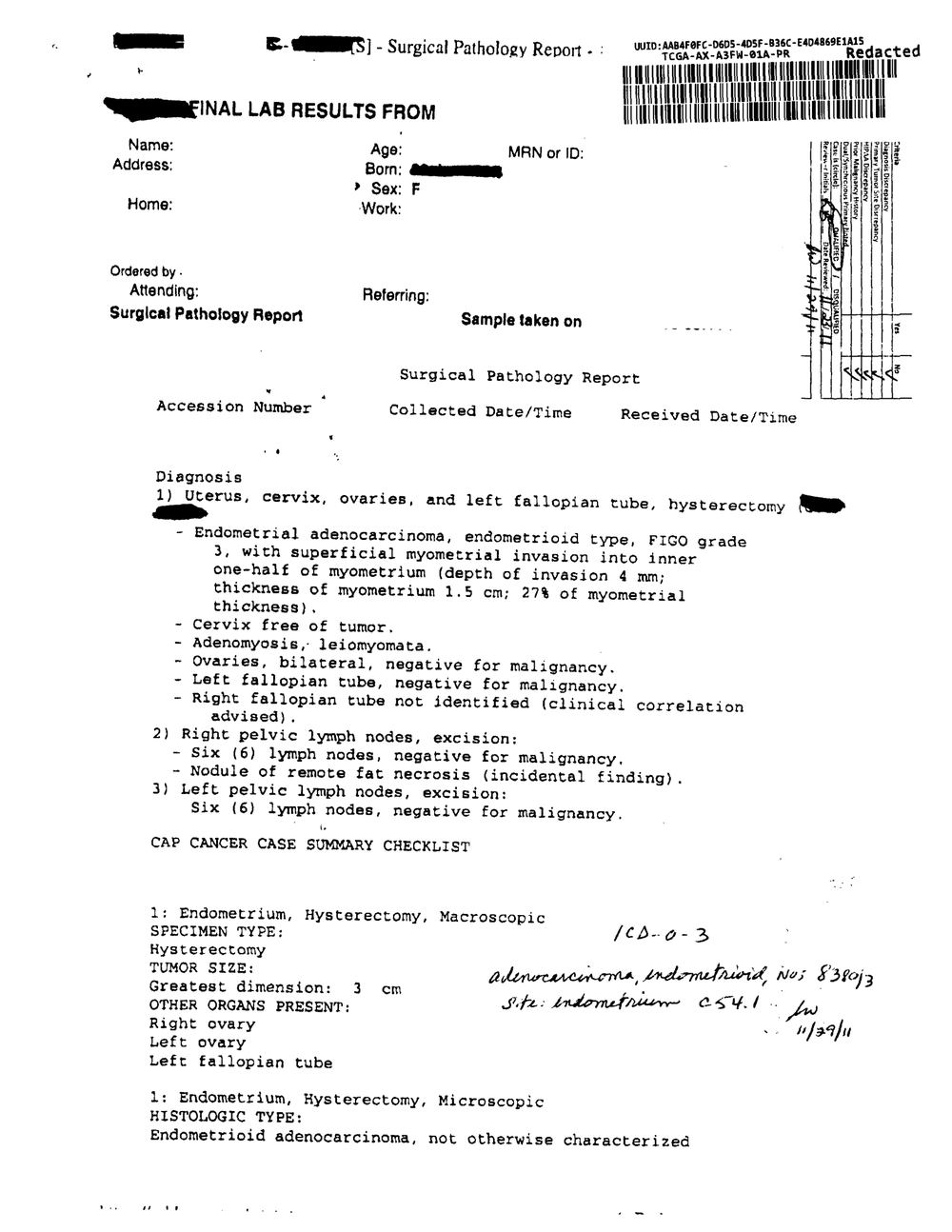
Recognized text
| Field | Value | Conf |
|---|---|---|
| Histologic type | endometrioid | 0.95 |
| Histologic grade (FIGO) | 3 | 0.85 |
| Myometrial invasion % | 26.7 | 0.90 |
| Cervical stromal invasion | absent | 0.90 |
| LVSI | no value yet | |
| Regional lymph node status | 0/12 negative (right pelvic 0/6, left pelvic 0/6) | 0.90 |
| Pathologic stage | pT1b [IB] pN0 pMX | 0.85 |
| Molecular classification | no value yet |
Provinans reads the scanned page, so handwriting, stamps, and checkboxes stay in the record. In the TCGA endometrial archive, a handwritten cover sheet appears on 498 of 548 scans and in none of the transcribed texts.
Each finding maps to a field and value your team defines, under the classification that governed the original report.
Every value links to the region of the page it came from. Your team confirms or corrects it, and the same configuration runs on every record that follows.
2nd Place, Built with Claude: Life Sciences Global Challenge
“There is so much data available through academic hospitals and other collaborations, but extracting its full value remains incredibly difficult. This is a great approach, with so many potential use cases, and I’m really excited about it.”
“I loved the amount of careful work that went into this project. This is going to have real impact.”
Define the fields you need, review proposed mappings, and refine how information is extracted and interpreted.
Save definitions, exceptions, and reviewed decisions in configurations you can edit, reuse, and adapt as requirements change.
When cancer classifications change, historical records need another look. Provinans helps map findings from archived pathology reports to a study’s current requirements, keeping source evidence, missing information, and expert decisions visible.
Read the case study →Provinans proposes how each field in your dictionary maps to a clinical concept, and brings the ambiguous ones to your team, such as one field that holds three lab results.
Each drafted value sits beside the report passage it came from. A reviewer confirms it, and the decision is saved with its evidence.
Confirmed values roll up into a cohort view: review progress, distributions, the reason behind each missing value, and outcomes joined from clinical records.
We’re developing laptop-scale extraction alongside configurable rules and expert review.